

 Tolulope Michael
What Is a Hash Function? A Simple Cybersecurity Guide for Beginners
A hash function is a mathematical process that takes any data and turns it into a fixed-length output called a hash value. It does not matter if the input is short or large; the output size stays the same.
In cybersecurity, hashing helps protect sensitive data, verify file integrity, and secure systems against tampering.
In this guide, we will answer the question: what is a hash function, how a hash function works, and how cybersecurity professionals use it in real-world situations.

What Is a Hash Function in Computer Science?
A hash function in computer science is a tool that converts data into a unique string of characters. This output is known as a hash or hash value.
You can think of a hash as a digital fingerprint.
- Every input creates a specific output
- The same input always gives the same result
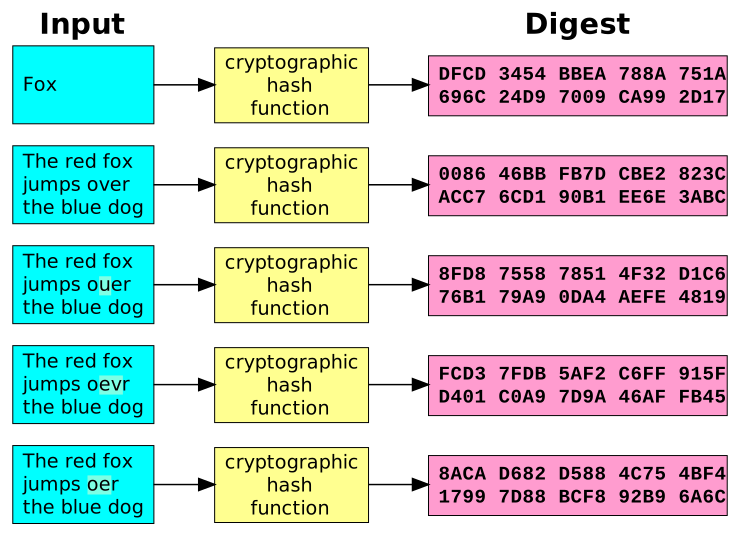
- A small change in input creates a completely different hash
For example, the word “data” and “Data” will produce two completely different hash values.
This process is called hashing.
In simple terms:
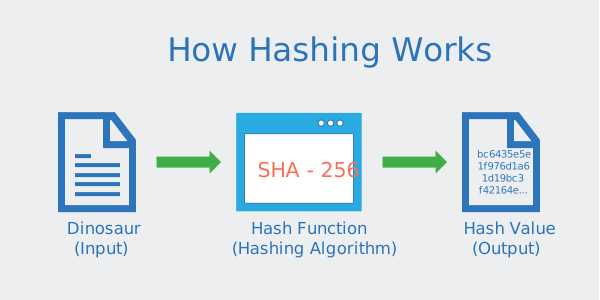
- Input → any data (text, file, password)
- Process → hash function algorithm
- Output → fixed-length hash value
This is why people often ask “what is a hash in data” or “what hashing means.” It simply means turning data into a coded form that represents it without revealing the original content.
RELATED ARTICLE: Mobile Network Virtual Operator in 2026: Meaning, Types, Examples
How Hash Functions Work
To understand how a hash function works, focus on what happens behind the scenes.
A hash function algorithm takes your input and runs it through a set of mathematical operations. It then produces a fixed-length output known as the hash value.
Here is the process in simple steps:
- You enter data (text, file, or password)
- The system applies a hashing algorithm
- The algorithm transforms the data
- You get a fixed-length output
No matter how large the input is, the output length remains constant.
A key feature of hashing is this:
A tiny change in the input creates a completely different output.
For example:
- “Hello World” → one hash value
- “hello world” → a completely different hash value
This behavior makes hashing powerful for security.
Another important point:
Hashing works in one direction.
You can create a hash from data, but you cannot easily reverse the hash to get the original data. This is why hashing plays a major role in cybersecurity.
What Makes a Good Hash Function?
A strong hash function must meet specific conditions.
These properties make hashing reliable and secure:
Deterministic
The same input always produces the same output.
Fixed Output Size
The output length stays constant, no matter the input size.
Avalanche Effect
A small change in input creates a large and unpredictable change in output.
Collision Resistance
Two different inputs should almost never produce the same hash value.
One-Way Function
It should be extremely difficult to reverse the hash back to the original data.
In more advanced systems, developers also consider concepts like independent uniform hashing, which helps distribute outputs evenly and reduce collisions.
These properties define what a secure and useful hash function looks like.
READ MORE: Messaging Security Agent: Protecting Your Business Communications in 2026
What Is a Hash Function in Cryptography?
A hash function in cryptography plays a key role in protecting digital systems.
Instead of storing or sending raw data, systems use hashing to create secure representations of that data.
Hashing supports:
- Digital signatures
- Message authentication
- Data integrity checks
For example, when you send a message, the system can generate a hash of that message. The receiver can generate the same hash again and compare results.
If both hashes match, the message has not been altered.
This makes hashing a core part of modern cryptographic systems.
What Is Hashing in Cyber Security?

When people ask what hashing is in cyber security, they usually mean how it protects real systems.
Hashing appears in many everyday security processes:
Password Storage
Systems store a hashed password, not the actual password. If a database leaks, attackers only see the hash, not the original password.
File Hashing
Security teams use file hashing to check if a file has been changed or corrupted.
Malware Detection
Each file has a unique hash value. Security tools use hashes to identify known malicious files.
Data Integrity Checks
When downloading software, you can compare hash values to confirm the file has not been altered.
Hashed Identifiers
Systems use hashed identifiers to protect user data while still allowing tracking and verification.
This is why hashing is part of cyber security fundamentals.
SEE ALSO: Multitenant Database Containers and Their Role in Cybersecurity
Hash Function Example
Let’s look at a simple hash function example.
If you input:
Hello World
A SHA-256 function will produce a fixed 64-character string.
If you change it to:
hello world
The output becomes completely different.
This shows two important things:
- Hashing is sensitive to input changes
- Hash values act like unique fingerprints
This is why hashing works well for detecting tampering.
Hashing vs Encryption
Many people confuse hashing with encryption.
They serve different purposes.
Hashing
- One-way process
- Cannot easily reverse
- Used for verification and integrity
Encryption
- Two-way process
- Can be reversed with a key
- Used to protect data in transit
Think of hashing as a seal that shows whether something changed, while encryption hides the content itself.
MORE: What is CVV2 Credit Card and Debit Card Security?
Types of Hash Functions You Should Know
There are different types of hash functions, but some are more important than others.
MD5
Fast but no longer secure. Avoid using it for sensitive data.
SHA-1
Also outdated due to security weaknesses.
SHA-2 Hashing (e.g., SHA-256)
Widely used and considered secure for most applications.
Password Hashing Algorithms (bcrypt, Argon2)
Designed specifically for hashing passwords with added protection.
Choosing the right hash function depends on the use case.
What Is a Hash Function in JavaScript?
A hash function in JavaScript allows developers to generate hash values using libraries or built-in tools.
Developers use hashing in JavaScript for:
- Password protection
- Data validation
- API security
Most real-world applications use trusted libraries instead of building custom hash functions.
Conclusion
A hash function turns data into a secure, fixed-length value that helps protect systems and verify information.
Understanding what hashing is gives you a strong foundation in cybersecurity.
From password protection to file verification, hashing plays a critical role in keeping digital systems safe.
Build a High-Income Cybersecurity Career with Tolulope Michael
Ready to move beyond theory and start using skills like hashing, encryption, and real-world security practices to land a high-paying cybersecurity role? Book a one-on-one session with Tolulope Michael today and learn how to turn foundational knowledge into a job-ready skillset.
In this session, you’ll learn:
- How cybersecurity concepts like hashing, password security, and data integrity are applied in real job roles
- The exact roadmap to transition into high-paying cybersecurity roles, even without a technical background
- How to position your experience to get interviews and stand out in the cybersecurity job market
Take the next step from learning to earning. Book your session now and get clear, practical guidance on how to break into cybersecurity and start building a six-figure career.
FAQ
What are the three types of hash functions?
Hash functions fall into three main groups based on how people use them.
Cryptographic hash functions like SHA-256 protect sensitive data and support security systems.
Non-cryptographic hash functions like MurmurHash help with fast data processing in applications like hash tables.
Password hashing functions like bcrypt and Argon2 are designed specifically to secure passwords against attacks.
Why do we use a hash function?
We use a hash function to protect data, verify integrity, and improve system performance.
In cybersecurity, hashing helps store passwords safely, detect file changes, and confirm that data has not been tampered with during transmission.
What is SHA-256 and MD5?
SHA-256 and MD5 are two well-known hashing algorithms.
SHA-256 is part of the SHA-2 family and is widely used in cybersecurity because it offers strong security.
MD5 is an older algorithm that is fast but no longer secure for protecting sensitive data due to known vulnerabilities.
What is the difference between a hash function and HashMap?
A hash function is an algorithm that converts data into a fixed-length value.
A HashMap is a data structure that uses a hash function to store and retrieve data quickly.
In simple terms, the hash function creates the key, while the HashMap uses that key to organize and access data efficiently.
